
The Landscape Research Group (LRG) is delighted to announce the recipients of the 2026 LRG Research Fund, supporting four innovative projects that exemplify emerging directions in landscape research.
This year’s funding call, Reimagining Landscape Change: Methods and Tools for a Transforming World, invited researchers to rethink how landscapes are understood, documented and interpreted during a period of profound environmental and social change. Proposals were encouraged to develop interdisciplinary, innovative and methodologically advanced approaches spanning planetary systems, intimate lived environments and human and more-than-human relationships.
The response was extraordinary.
LRG received 70 applications from researchers around the world, making this an exceptionally competitive funding round. Collectively, the proposals demonstrated the breadth and vitality of contemporary landscape research, exploring subjects and methods ranging from Indigenous knowledge systems, oral history and participatory mapping to creative practice, digital visualisation, ethical research and landscape biography.
The outstandingly high quality of the entries made the final decisions particularly challenging. Following detailed assessment by LRG trustees, four projects were selected for funding.
Although geographically and culturally diverse, the successful projects share a central ambition: to develop new ways of knowing landscapes. Each advances methodology as well as knowledge of a particular place, creating approaches and resources with the potential to benefit communities, practitioners and landscape researchers beyond the immediate project.
2026 LRG Research Fund recipients
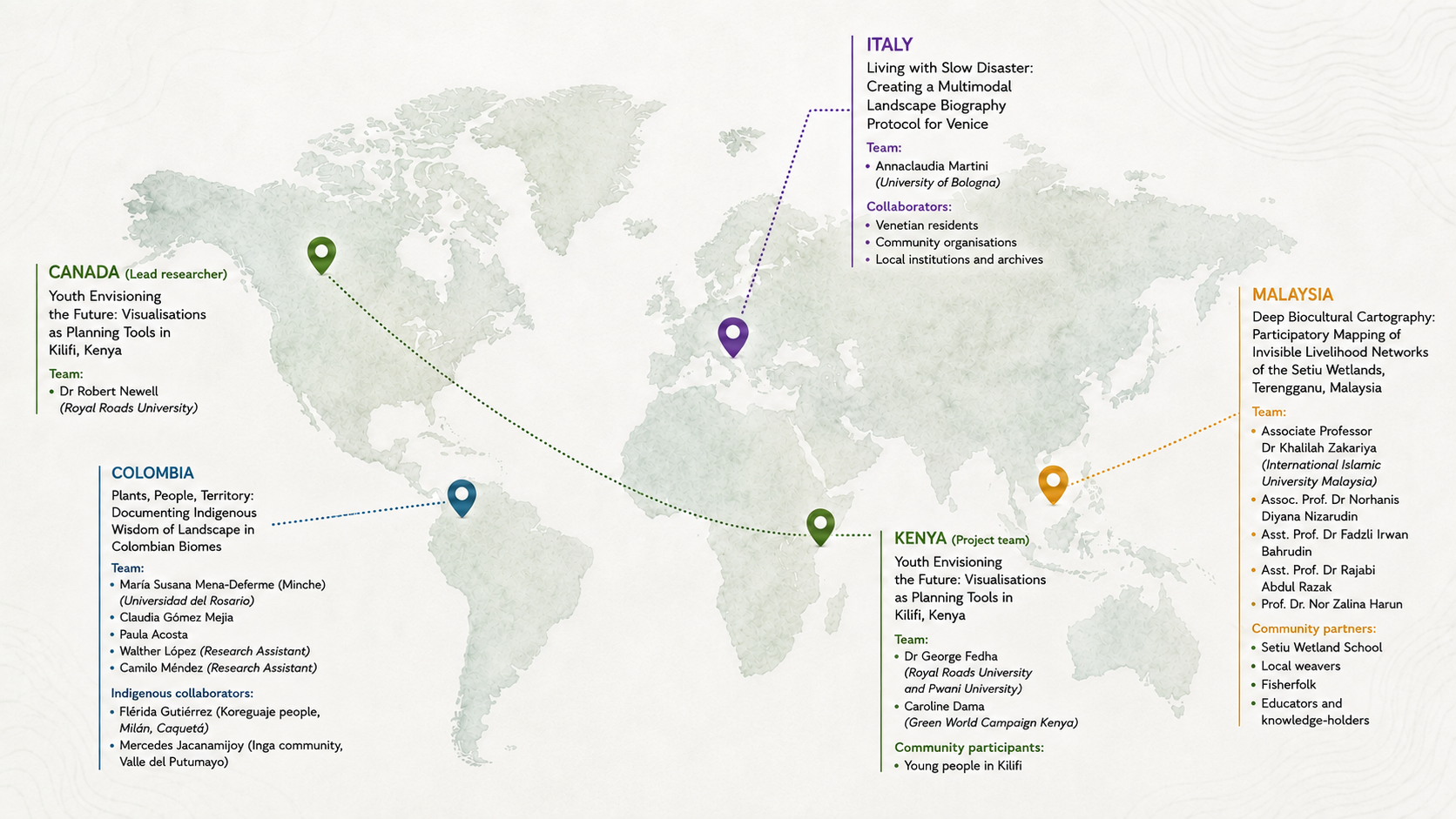
Deep Biocultural Cartography: Participatory Mapping of Invisible Livelihood Networks of the Setiu Wetlands, Terengganu, Malaysia
Led by Associate Professor Dr Khalilah Zakariya (International Islamic University Malaysia (IIUM)), this interdisciplinary project brings together Associate Professor Dr Norhanis Diyana Nizarudin (IIUM), Assistant Professor Dr Fadzli Irwan Bahrudin (IIUM), Assistant Professor Dr Rajabi Abdul Razak (IIUM), and Prof. Dr Nor Zalina Harun (Universiti Kebangsaan Malaysia (UKM)) working alongside community partners at the Setiu Wetland School and local weavers, fisherfolk, educators and other knowledge-holders.
Together, the team will develop a Deep Biocultural Cartography methodology combining participatory mapping, oral histories, GIS and artistic visualisation. By documenting relationships between local livelihoods, cultural practices and wetland ecosystems, the project aims to make often-overlooked biocultural knowledge more visible while creating practical resources for conservation, education and sustainable community development.
Living with Slow Disaster: Creating a Multimodal Landscape Biography Protocol for Venice
Led by Annaclaudia Martini (University of Bologna), this project works in close partnership with Venetian residents, local organisations and cultural institutions to explore how communities experience landscapes undergoing gradual but profound environmental change.
Using Venice and its lagoon as a living laboratory, the research combines oral histories, walking interviews, archival research, affective mapping and multimedia documentation to develop a new multimodal landscape biography methodology. The resulting protocol is intended to provide researchers with an adaptable framework for studying landscapes shaped by long-term environmental change while placing local knowledge and lived experience at its heart.
Plants, People, Territory: Documenting Indigenous Wisdom of Landscape in Colombian Biomes
María Susana Mena-Deferme (Minche) (Universidad del Rosario, Colombia) leads a multidisciplinary team including Claudia Gómez Mejía, Paula Acosta, research assistants Walther López and Camilo Méndez, together with Indigenous collaborators Flérida Gutiérrez and Mercedes Jacanamijoy, whose knowledge and experience are central to the research.
Working collaboratively across the Amazonian and Andean biomes, the team will develop and test the Plant, Process, Memory methodology, bringing together ethnobotany, oral history and material culture to document Indigenous landscape knowledge through ethical, community-led research. The project will culminate in an open-access bilingual methodology designed for wider international use.
Youth Envisioning the Future: Visualisations as Planning Tools in Kilifi, Kenya
Led by Dr Robert Newell (Royal Roads University, Canada), this international collaboration brings together researchers with Green World Campaign Kenya, local government partners and young people in Kilifi to explore how immersive visualisation technologies can strengthen participation in planning for nature-based solutions.
Using interactive digital environments created with video game software, participants will explore alternative landscape futures and evaluate their opportunities and challenges together. By placing young people at the centre of decision-making, the project aims to develop practical methods that can support more inclusive landscape planning and governance.
A strong year for international landscape research
The LRG Research Fund was established in 2017 and supports high-quality projects aligned with the organisation’s strategic priorities. It is intended to help researchers test new ideas, develop methodologies, build collaborations and produce work that advances landscape research while delivering clear public benefit.
This year’s selected projects reflect the international and interdisciplinary character of LRG’s community. They connect research institutions and communities across Malaysia, Italy, Colombia, Kenya and Canada while demonstrating the different forms that methodological innovation can take.
Dr Merham Keleg, LRG Research Lead, said:
“The quality and diversity of this year’s applications were exceptional. Across the submissions, we saw researchers developing thoughtful and ambitious new ways to understand landscapes and the relationships that people have with them. Selecting only four projects from such a strong field was extremely difficult. We warmly congratulate the successful teams and thank every applicant for the care, creativity and commitment evident in their proposals.”
The funded projects will run during 2026 and 2027, with their methods and findings shared through publications, community resources, events and LRG platforms.
Over the coming weeks, we hope to publish interviews with members of each of the four recipient project teams. These will introduce the people behind the research, explore how their projects developed and offer further insight into the methods they are creating and the contribution they hope to make.
We look forward to sharing their stories and following the progress of all four projects over the coming year.