
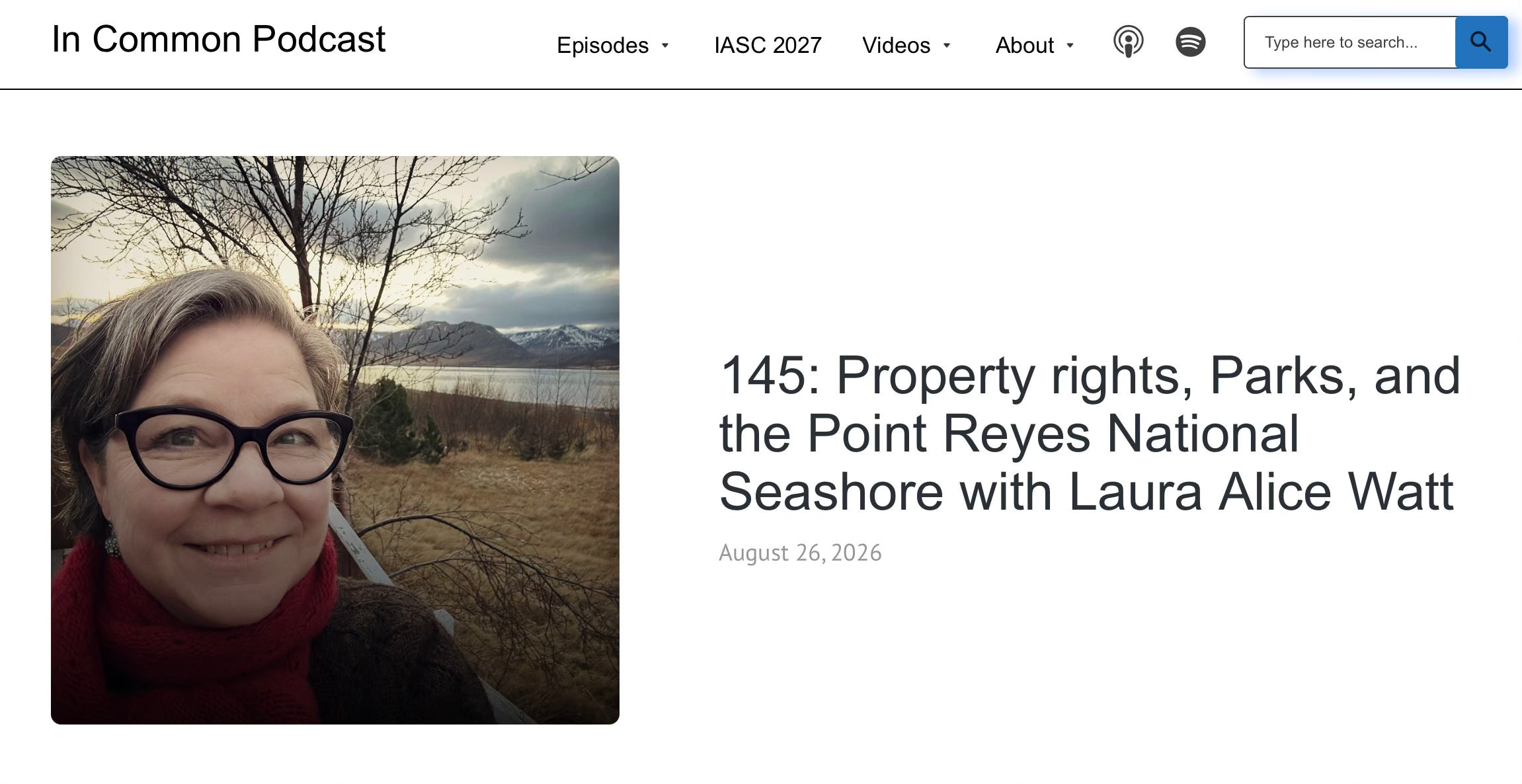
Landscape Research Group Chair Professor Laura Alice Watt is the guest on a new episode of the In Common podcast, discussing the research behind her book The Paradox of Preservation: Wilderness and Working Landscapes at Point Reyes National Seashore and the continuing debate over the future of this Californian landscape.
Published on 26 August 2026, the 108-minute episode—Property rights, Parks, and the Point Reyes National Seashore with Laura Alice Watt—explores the history of Point Reyes, a dramatic coastal landscape north of San Francisco where national park conservation has long coexisted, sometimes uneasily, with dairy farming, cattle ranching, fishing and oyster cultivation.
Laura is Professor Emerita of Geography, Environment and Planning at Sonoma State University and Chair of LRG’s Board of Trustees. Her work brings together environmental history, cultural geography, protected-land policy and landscape theory.
A working landscape under preservation
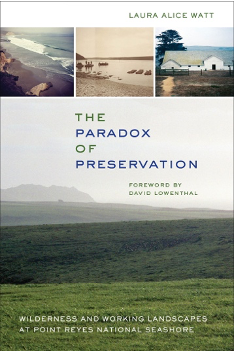
Laura began researching Point Reyes in 1997 for her doctoral dissertation, asking what happens to a working agricultural landscape when it becomes the subject of preservation. Her subsequent research expanded considerably as conflict developed around the Drakes Bay Oyster Company, an operation that pre-dated the creation of the National Seashore but was eventually closed in 2014.
The resulting book—with a foreword written by LRG co-founder and former Chair David Lowenthal—examines how inherited ideas about what a national park “ought to be” influence the treatment of lived-in and worked landscapes. It traces the establishment and management of Point Reyes National Seashore, asking how preservation policies can affect local residents, livelihoods, cultural histories and the landscapes those activities have helped to create.
Published by the University of California Press in late 2016, with an official publication date of 2017, The Paradox of Preservation is now approaching its tenth anniversary. Its questions remain highly relevant: must protection mean removing productive human activity, or can cultural use and ecological value be understood and managed as parts of the same landscape?
“Nearly ten years after the book was published, I’m proud that it continues to contribute to conversations about what preservation means in lived-in, working landscapes. So much has changed at Point Reyes, in ways that were sadly predictable, but the need for careful research, clear arguments and decisions grounded in the full historical record feels more important than ever.” Professor Laura Alice Watt
Looking back—and at what followed
In the podcast, Laura traces the Point Reyes conflict from the park’s foundation through the oyster-farm controversy and the more recent dispute over ranching. The specifics of this story are couched within the broader history of parks establishment in the U.S., National Park Service attitudes about private ownership within protected areas, and contradictions that can arise when trying to balance conservation of natural and cultural systems.
The episode also brings the book’s story up to date. A January 2025 legal settlement resulted in most remaining ranching operations at Point Reyes closing. According to the podcast’s accompanying notes, 12 ranches had departed by April 2026, leaving two in operation. Supporters have presented the change as an opportunity for wildlife protection and ecological restoration, while opponents see it as the displacement of a long-established community and the loss of an important working landscape.
Writing about the new episode on her fjordlight blog, Laura reflects on this outcome and on almost three decades of involvement with Point Reyes. Although she remains proud that the book continues to inform debates about preservation, she also expresses sadness at the disappearance of most of the Seashore’s working landscape and frustration at the selective use of historical and environmental evidence in polarised policy disputes.
Her reflections underline a wider challenge for landscape research and practice: how to build decisions on sound evidence while recognising that landscapes hold multiple—and sometimes competing—natural, cultural, historical and economic meanings.
The new podcast offers an engaging introduction to these questions and an opportunity to revisit a book whose central concerns have only become more urgent.
Read Laura’s reflections on the fjordlight blog
Find out more about The Paradox of Preservation from University of California Press
The book is also available through JSTOR, subject to individual or institutional access, and can be previewed on Google Books.